Cash vs Accrual
Run statements on accrual or modified cash basis. Your books stay on accrual; the cash view drops open receivables and payables.
Accrual counts a sale or expense when the work happens. Cash counts it when the money moves. Lejr shows your statements either way from one set of books.
Your ledger always stays on accrual. Cash basis is calculated when a report runs, so switching changes how statements read, never what's posted.
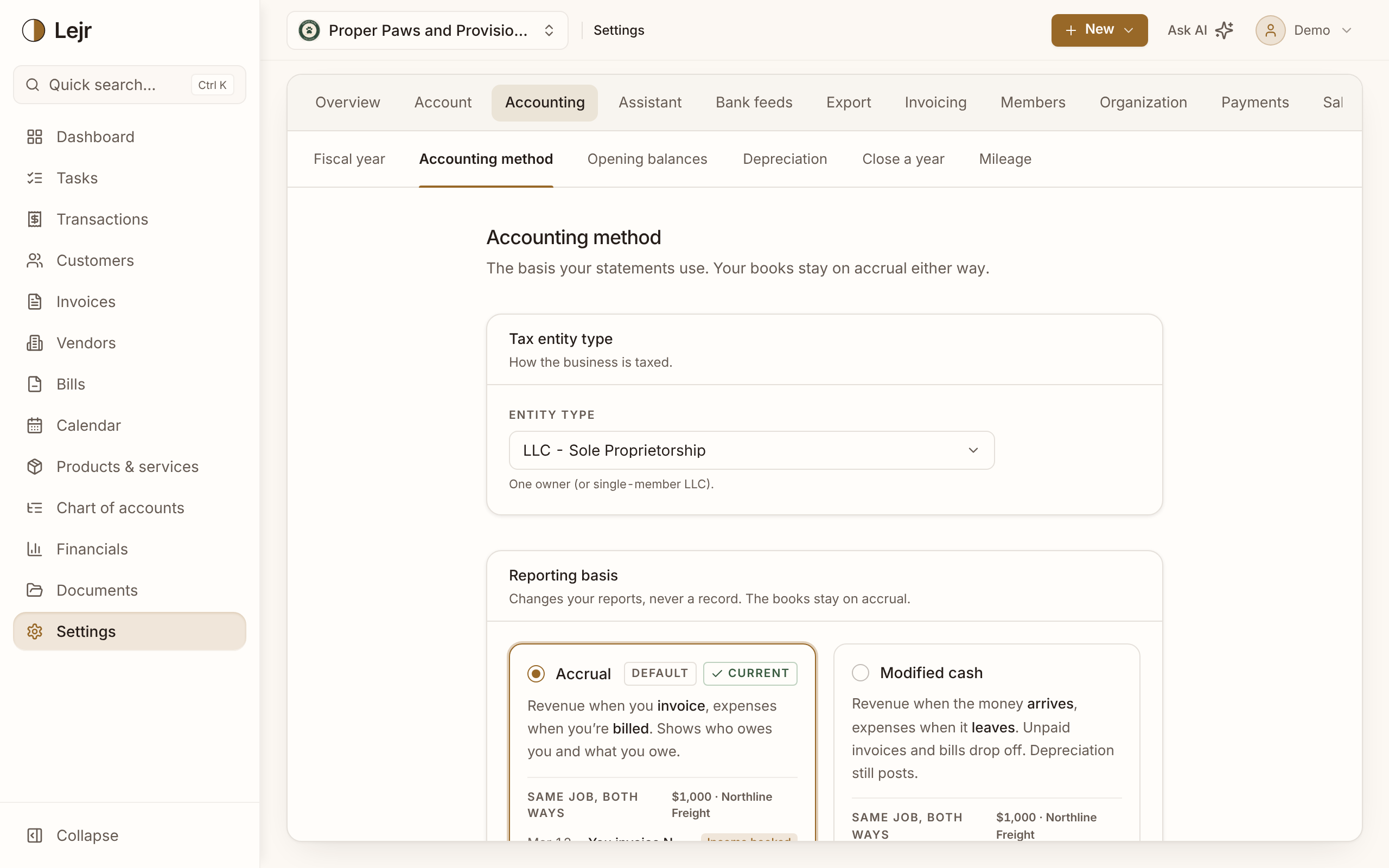
Choosing your basis
- Open the setting
Go to Settings → Accounting → Accounting method and find Reporting basis. Accrual is the default.
- Pick a basis and save
The choice applies to the whole organization, so everyone sees the same statements. You can switch back at any time.
- Check the header
Each statement prints its basis in the header, so your accountant knows which one produced it.
Modified cash basis
Lejr's cash basis is modified cash basis, a recognized special-purpose framework. It changes only the timing of receivables and payables and keeps everything else as booked.
On cash basis, income counts when money arrives and expenses when money leaves, so unpaid invoices and bills drop off, along with the sales tax on the unpaid part. Fixed assets stay capitalized and depreciated, prepaid expenses still amortize, and customer deposits stay a liability until earned.
An asset bought on an unpaid bill (equipment, a prepaid, inventory) stays on the balance sheet, with what you owe in Accounts Payable. A bill paid by the owner personally or straight from a loan or credit line counts as paid that day, as does an invoice paid to the owner personally.
Even a cash-method taxpayer must capitalize and depreciate a fixed asset, so dropping depreciation would make cash-basis statements less correct.
Why the books stay on accrual
Accrual records the full event: the receivable when you invoice, the payable when you're billed. Cash basis can always be derived by removing what hasn't settled, but cash records can't be turned back into accrual. Keeping the ledger on accrual means there's nothing to migrate and last quarter's reports can always be reproduced.
What follows the basis
The income statement, balance sheet, cash flow statement, trial balance and dashboard figures follow the setting. On cash basis, the trial balance takes balance-sheet accounts from the cash-basis balance sheet and revenue and expenses from the cash-basis income statement. The accrual-to-cash difference in equity is shown on its own lines, so debits still equal credits.
The CPA tax package uses your basis too, and its README names it. Its general ledger lists entries as posted, and its supporting schedules aren't restated: the fixed-asset register, reconciliations and loan schedule read the ledger as posted, aging shows what was owed at year end, and the sales tax report shows both bases.
Good to know
- This changes your statements, not your tax return. Changing the method you file on is an IRS change of accounting method that usually needs Form 3115. Ask your accountant first.
- Beginning and ending cash are the same on both bases.
Common questions
- Does switching to cash basis change my ledger?
- No. Cash basis is calculated when a report runs. Nothing is reposted, and switching back is instant.
- Why does depreciation still show on cash basis?
- Modified cash basis keeps fixed assets capitalized and depreciated, as the IRS requires even of cash-method taxpayers. You can't expense the whole cost the day you buy the asset.
- Can different people see different bases?
- No. The basis is one setting for the organization, and every statement names the basis it used.